Locker Room Lockers: Athletic Director's Selection Guide
Locker Room Lockers: The Athletic Director’s Complete Selection Guide
A locker room locker purchase is one of the most permanent facility decisions an athletic director makes. Get it right and you won’t think about it again for 20–30 years. Get it wrong and you’ll be managing the consequences, frustrated athletes, maintenance requests, premature replacement cycles, and a room that sends the wrong message to every recruit who walks through the door, until someone finally fixes it properly.
This is the guide that makes sure you get it right the first time.
At PlayerStall, we’ve built custom wood locker room lockers for collegiate and high school athletic programs for over 35 years. We’ve seen every version of this purchase, the thoughtful specification that produced a 25-year installation, and the price-driven decision that produced a 7-year regret. This guide captures the complete decision framework: material selection, sizing by sport, ventilation, hardware, security, customisation, vendor evaluation, RFP writing, and total cost of ownership modeling.
Everything you need. One decision, made correctly.
Key Takeaways
- Material is the highest-stakes decision in any locker room locker purchase, solid 3/4” birch wood outperforms metal and laminate on every 20-year performance metric
- The six dimensions of locker quality are material, construction, size, ventilation, hardware, and customisation, programs that evaluate all six make better purchases
- Football and hockey require 30”–36” wide lockers; basketball, soccer, and baseball need 24”–30” with sport-specific interior configurations
- Ventilation is the most-overlooked factor, sealed lockers in athletic environments accumulate moisture and odor that degrade equipment and surfaces within 2–3 years
- The 20-year total cost of ownership for solid wood lockers is lower than metal or laminate when replacement cycles and installation labor are properly accounted for
- A complete purchasing RFP specification should include material species, panel thickness, warranty scope, and installation responsibility, omitting any of these gives suppliers room to substitute inferior components
In This Guide
- Why Locker Selection Matters More Than Most athletic directors Think
- The 6 Dimensions of Locker Quality
- Full Material Comparison: Wood vs. Metal vs. Laminate
- Sport-Specific Selection Guide
- Ventilation: The Most Overlooked Factor
- Hardware and Security Options
- Customisation That Drives Recruiting Value
- How to Write Locker Specifications for a Purchasing RFP
- Total Cost of Ownership: The 20-Year Model
- Questions to Ask Every Vendor Before Purchasing
- Frequently Asked Questions
Why Locker Selection Matters More Than Most athletic directors Think
Every coach will tell you the locker room is where program culture lives. It’s where the team gathers before competing, where they decompress after a loss, where individual athletes become a unit. The physical environment of that space, its quality, its energy, its message about what the program values, shapes culture in ways that are real and measurable even if they’re hard to quantify.
From a purely operational standpoint, locker room lockers are the athletic facility component with the longest service life and the highest replacement cost relative to initial investment. A HVAC system gets replaced on a 15–20 year schedule. Flooring gets refinished every 5–7 years. But locker room lockers, once installed, are expected to function indefinitely, and the only realistic replacement trigger is failure.
Programs that buy cheap fail in predictable ways: the lockers look dated within 5 years, start showing real wear at year 7–8, and become a genuine maintenance and morale issue at year 10. Then you’re buying lockers again, plus installation, plus dealing with the disruption of a mid-decade renovation. The initial “savings” cost more than the premium product would have.
The programs we’ve worked with over 35 years that report the most satisfaction with their locker room investment are the ones who evaluated the full lifecycle, not the purchase price. That’s what this guide helps you do.
The 6 Dimensions of Locker Quality
Evaluate any locker room locker purchase across these six dimensions. Programs that check all six make purchases they’re satisfied with for 20+ years. Programs that focus on two or three and guess on the rest create problems for themselves.
Material is the foundation. What is the locker built from, how thick are the structural panels, and how does that material perform under the specific conditions of an athletic locker room, moisture, temperature variation, physical impact, and continuous use?
Construction is how the material is assembled. Even solid birch can be poorly built if the joinery is weak, the back panels are undersized, or the shelf standards are inadequate for real load-bearing use. Ask for construction details, not just material descriptions.
Size is the match between locker dimensions and actual athlete equipment volume. An undersized locker creates daily operational failure, gear ends up on the floor, athletes can’t close doors, and the room looks disorganized regardless of its quality level.
Ventilation is the difference between a locker that keeps gear fresh and one that accumulates odor and moisture damage. More on this below, it’s the most underweighted factor in most purchasing decisions.
Hardware determines daily usability and security. Hinge quality, handle design, and lock mechanisms are the components athletes interact with hundreds of times per year. Cheap hardware fails early and signals quality problems every time it does.
Customisation is where a storage system becomes a program environment. Player nameplates, team colors, logo integration, and technology features turn a functional room into a recruiting tool and a culture statement.
Full Material Comparison: Wood vs. Metal vs. Laminate
The athletic locker market offers three real material options. They are not comparable alternatives, they perform at fundamentally different levels over a 15–25 year facility lifecycle.
Solid 3/4” Birch Wood
This is the construction standard we’ve used for over 35 years, and there’s a reason we haven’t moved to cheaper alternatives despite market pressure. Solid 3/4” birch is dense enough to resist surface denting and gouging from daily equipment contact. It doesn’t corrode. It doesn’t amplify sound the way metal does (the acoustic environment of a wood locker room is categorically warmer than a metal one). It accepts paint, stain, engraving, and custom hardware in ways that allow genuine program identity expression.
The five year guarantee we back our lockers with reflects real confidence in solid birch at this panel thickness, in practice the lockers last decades longer. We’ve had installations in service for 25+ years that look and function as specified. That’s not an accident of a favorable installation environment, it’s the material performing as engineered.
Metal
Metal lockers are ubiquitous in athletic facilities because they’ve been the default option for 60+ years. Familiarity is their primary advantage. Performance over a 15–20 year athletic lifecycle is not.
The specific failure modes of metal in athletic locker rooms are predictable and well-documented: paint adhesion failure at high-contact points (door edges, handle areas, corners) typically begins by year 5–6. Denting from equipment impact, shoulder pads, hockey bags, football helmets, is visible within 3–4 years in high-use rooms. Hinge and fastener corrosion in humid environments accelerates as surface finishes fail. By year 10–12, the average metal athletic locker room has visible dents on 30–40% of stations, localized rust spots at hinges and base joints, peeling paint on interior surfaces, and loose door alignment on multiple units.
Metal locker warranties typically run 5–10 years. Most programs expect to get 15–20 years from their locker room. That 5–10 year gap is where you discover what the warranty exclusions actually mean.
Particleboard/Laminate
Laminate lockers present a seductive value proposition: lower cost than metal, better-looking catalog photos, and a surface finish that looks like quality in a showroom setting. The core is particleboard, an engineered wood product that is extremely cost-effective in dry office environments and extremely problematic in athletic locker rooms.
Particleboard has essentially no moisture resistance. Athletic locker rooms generate continuous moisture from wet gear, post-shower humidity, and seasonal climate variation. When particleboard absorbs that moisture, it swells. Swelling at panel edges creates door gaps and misalignment. Swelling at shelf joints causes progressive delamination. The laminate surface, which is bonded to the particleboard core, begins to separate at high-stress points, typically the corners, edges, and handle areas that experience the most friction and impact.
We’ve visited facilities where a 6-year-old laminate locker room looked worse than a 25-year-old metal installation. That’s not a performance anomaly. That’s particleboard performing exactly as its material properties predict in an environment it was never designed for.
Sport-Specific Selection Guide
Locker dimensions are a direct function of equipment volume and athlete workflow. Here are the configurations we’ve optimized over 35 years of sport-specific builds.
Football
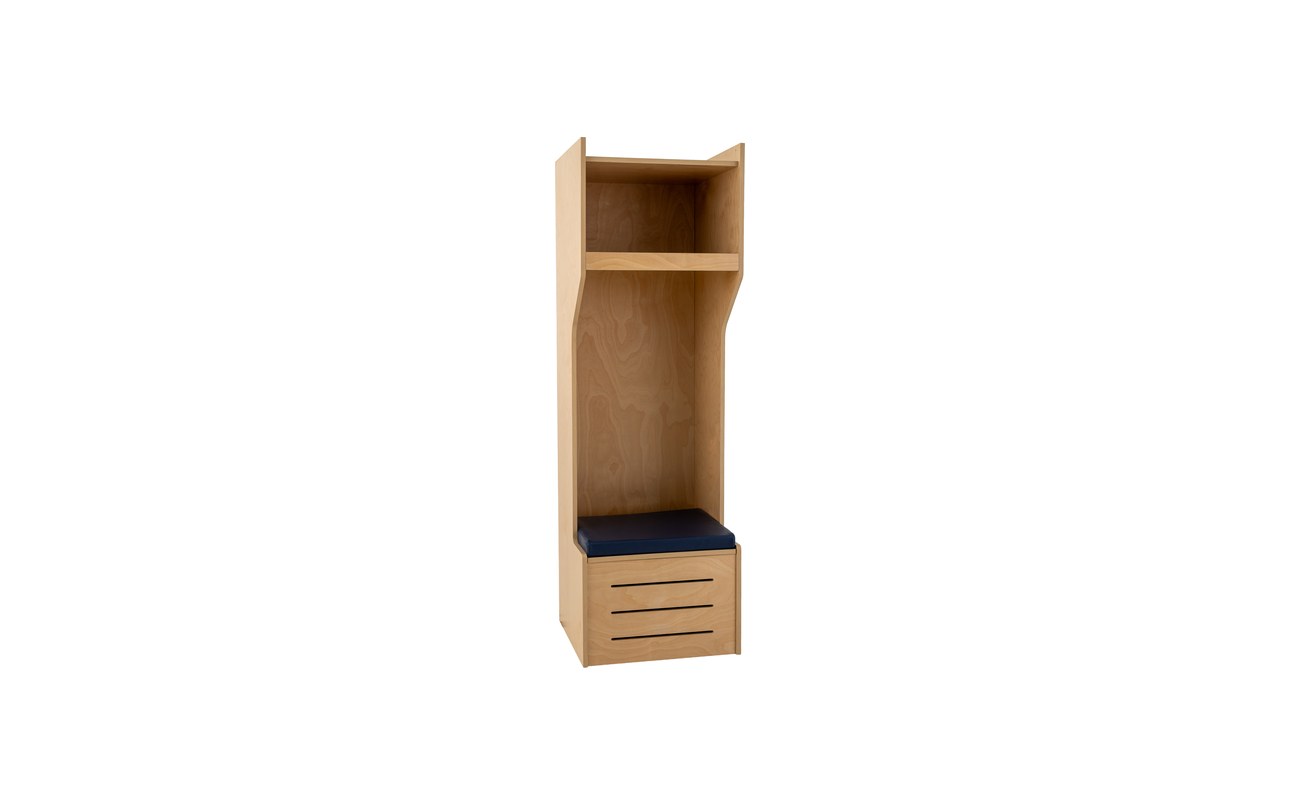
30”–36” wide, 76”–84” tall. Dedicated helmet shelf at mid-upper height, shoulder pad hooks rated 15+ lbs, full-height hanging bay for uniform sets, ventilated base cubby for cleats. For programs building flagship football facilities, 36” with multi-height hooks and a dedicated equipment shelf at the locker base handles the full equipment load without compromise. Coach stations are typically 24”–27” wide with the same vertical layout minus the oversized equipment hooks.
Hockey
30”–36” wide, 76” tall, with an interior configuration built specifically for hockey equipment drying. This means an elevated equipment shelf or hanging bar for chest protectors and shoulder pads, a base section with dedicated space for skates (including drainage for wet skates), and full ventilation throughout, both door panels and back panel airflow. Hockey gear stays wet for hours after use. A locker that can’t handle that moisture load creates a hygiene and equipment degradation problem on a daily basis. For detailed hockey locker design guidance, see our hockey lockers guide.
Basketball and Soccer
24”–27” wide, 72”–76” tall. These sports have lighter equipment loads but demand premium shoe storage, basketball and soccer players cycle through multiple shoe pairs and prioritize footwear condition. A base cubby sized for two pairs of athletic shoes with lateral airflow, a mid-height shelf for accessories, and a full hanging bay covers both sports well. Charging stations built into the locker station are increasingly expected rather than impressive at the high school varsity and collegiate level.
Baseball and Softball
24”–30” wide, 76” tall, with a dedicated vertical bat channel (48”–54” tall, 4”–6” wide) built into the locker’s interior structure. This is the configuration specification that distinguishes a baseball/softball locker from a general-purpose locker assigned to a baseball team. Add a batting helmet shelf at mid-height (with forward-stop lips to prevent rolling), a glove ventilation slot, and a ventilated cleat cubby at the base. Our baseball wood lockers complete guide covers every dimension of this design.
Multi-Sport Facilities
Programs running multiple sports through shared facilities need zone-based design: different locker widths for football versus basketball zones, sport-specific storage features per zone, and a layout that allows seasonal reconfiguration without moving furniture. A locker room where football players use the room in fall and basketball players use it in winter can serve both sports well, if it was designed for both sports, not averaged between them.
Ventilation: The Most Overlooked Factor
If you’re evaluating locker room lockers and ventilation isn’t on your list of questions, add it now. It is the single most-overlooked factor in athletic locker purchasing and the one most directly responsible for the outcome that ruins locker rooms faster than any other: accumulated moisture and odor.
Athletic gear is wet after use. Football pads, hockey equipment, soccer cleats, basketball shoes, wrestling singlets, all of these come off athletes who have been sweating for 1–3 hours and go directly into lockers where they sit until the next practice. A sealed or minimally ventilated locker turns that storage space into an anaerobic environment where bacteria thrive, odor accumulates, and surface moisture attacks both the gear and the locker interior.
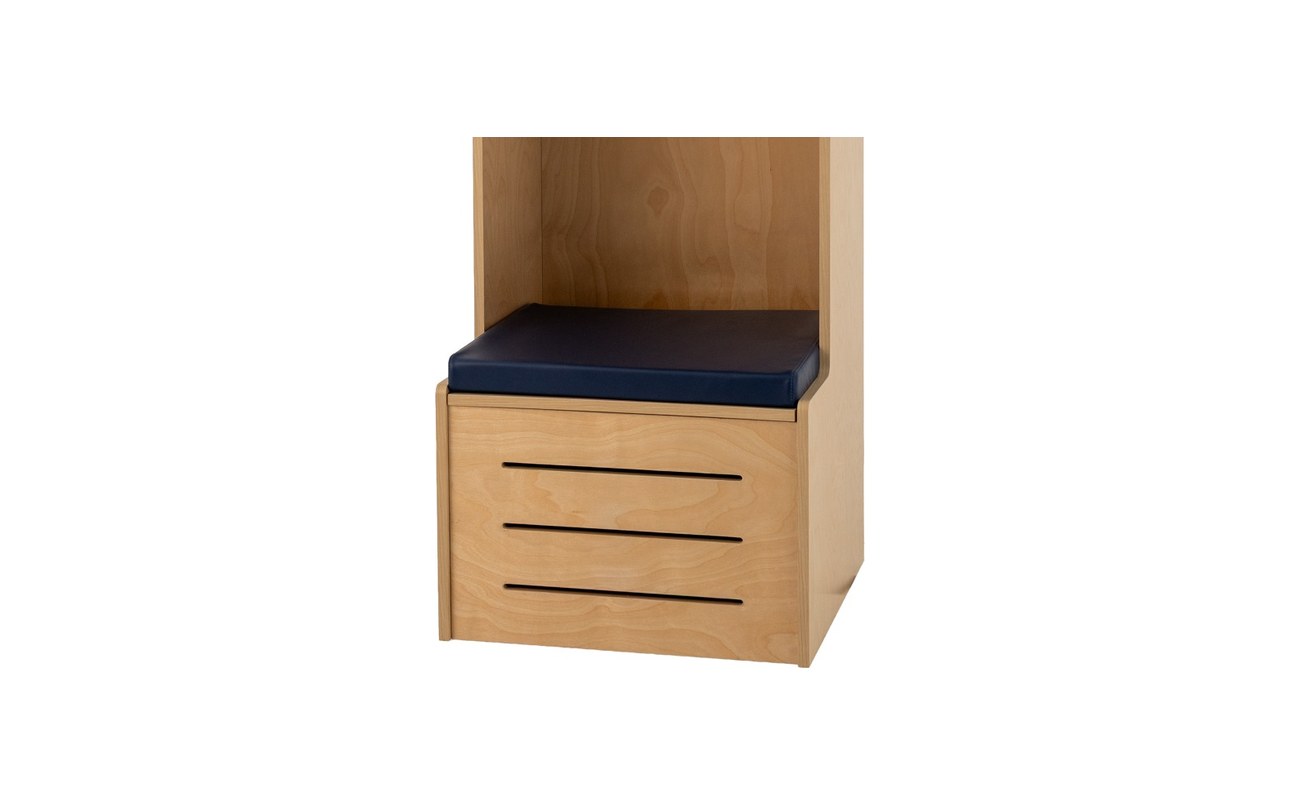
The solution is passive airflow: door panels with slatted or laser-cut ventilation openings that allow moisture to evaporate continuously, back panel or side panel ventilation that creates a cross-draft when the room’s HVAC system is operating, and base cubby designs that allow cleat moisture to evaporate rather than pooling.
Solid wood lockers with properly designed ventilation panels perform better than metal in this regard because the wood surface itself is slightly hygroscopic, it moderates humidity variation, while also providing a smooth, easy-clean surface for the residue that builds up in high-use lockers. Metal surfaces, once the paint finish begins to fail, accumulate odor and bacteria in the microscopic pitting of the exposed metal. You can see the difference in any aging metal locker room: the persistent odor that industrial cleaning products can’t fully eliminate.
Our lockers are built with ventilated door panels as a standard feature. It’s one of the construction choices that makes the five year guarantee realistic, not aspirational.
Hardware and Security Options
Hardware is the component athletes interact with most frequently, hundreds of times per year, per athlete. It’s also the component most suppliers treat as a cost-reduction opportunity. Don’t let them.
Lock Configurations
Padlock hasps are the simplest and most common configuration for high school programs, athletes bring their own padlock (combination or keyed, per program policy) and the locker provides a secure hasp. This minimizes the program’s hardware management burden but requires athletes to be responsible for their own lock.
Built-in combination locks add convenience for athletes and eliminate the lost-padlock problem, but require the program to track combinations and manage lock failures. For programs with high roster turnover, combination reset procedures become an operational consideration.
Master-key cylinder systems, where each athlete gets an individual key and coaching staff holds a master key that opens all lockers, are the standard for collegiate programs and strongly recommended for any locker room where emergency access to equipment matters. This is particularly relevant for medical emergencies, security incidents, or situations where a locked locker is blocking access to equipment needed immediately.
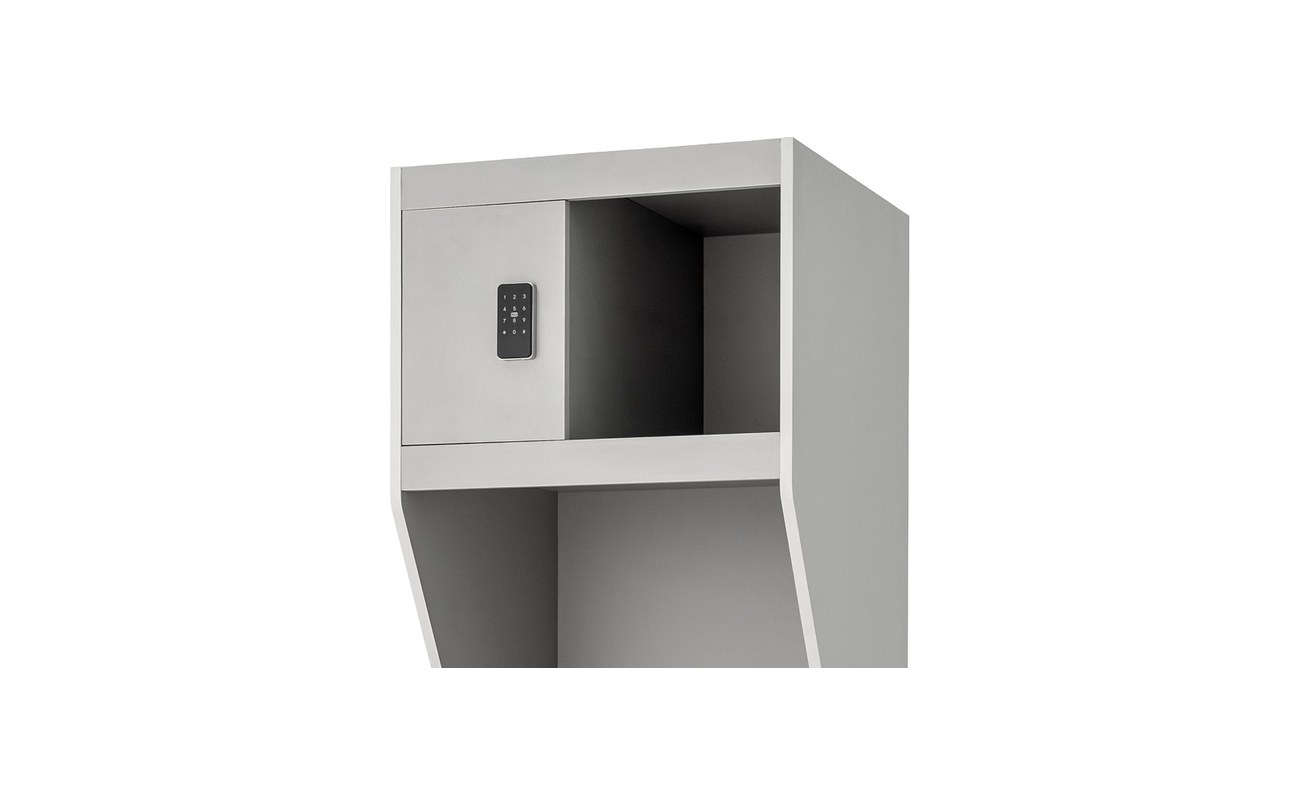
Electronic keypad and RFID systems offer the highest security and access logging capability, but at a significantly higher initial cost and ongoing maintenance burden. They’re appropriate for high-security storage of valuable equipment but are overkill for most standard locker room applications.
Hardware Quality Indicators
Ask suppliers for hinge specifications, not just the number of hinges. A door with three light-duty hinges isn’t better than a door with two heavy-duty hinges, it’s worse, because the lighter gauge material will fail at the mounting point first. Ask for the door weight rating and the hinge load rating explicitly.
Handle and pull quality directly affects daily use perception. Heavy-gauge recessed pulls, full-grip handles, and tight-tolerance door alignment characterize quality construction. Thin stamped-metal pulls that flex under normal grip pressure signal cost-reduction throughout the product.
Customisation That Drives Recruiting Value
The customisation conversation in athletic locker room purchasing often gets treated as optional, a premium upgrade for programs with strong budgets. That framing misses the point. Customisation is recruiting infrastructure.
Player nameplates with jersey numbers are the highest-impact customisation per dollar in an athletic locker room. A recruit on an official visit walks into your locker room and sees their name above a station. That experience, personal, specific, deliberate, communicates that your program noticed them as an individual before they arrived. It’s a moment coaches can’t replicate verbally. Budget for nameplates in every installation and budget for their replacement between recruiting classes.
Team color schemes and logo integration transform a storage room into a program environment. The visual identity your athletes see every day they suit up should reflect the program they’ve committed to. Full-color paint schemes, logo panel inlays, and hardware finishes that match your program’s aesthetic palette are not decorative, they’re environmental communication. They say: this program is professional, this program has standards, this program invested in you.
Charging stations, USB-A and USB-C ports built into each locker station, cost less than $50 per station to incorporate during initial construction and deliver years of daily value. Athletes under 22 treat their phones as essential training tools: film review, coach communication, music, GPS tracking. A locker room without charging is a locker room that gets partially ignored.
For a deeper look at the full recruiting ROI of locker room investment, our flagship sports lockers guide covers the research and case evidence in detail.
How to Write Locker Specifications for a Purchasing RFP
Programs that issue purchasing RFPs for locker room lockers, required by many school districts and collegiate procurement policies, need specifications that protect them from low-quality substitution. A vague specification invites the lowest-cost response. A specific specification gets you comparable bids on equivalent products.
Your RFP specification should include every one of the following: core material species and nominal panel thickness (e.g., “solid birch, 3/4” nominal”); panel construction method with explicit prohibition of particleboard cores; door construction and panel thickness; ventilation method with minimum free-air percentage or opening dimension; hinge specification, number, gauge, and load rating; hardware type, finish, and brand or equivalent; interior fitting list, specific hooks, shelves, hanging rods, cubbies, with mounting method and load ratings; finish type, color specification method (custom RAL, Pantone, or manufacturer standard), and customisation options included vs. excluded from base price; warranty terms with explicit coverage scope and exclusion list; installation responsibility, warranty, and scope of work; delivery, lead time commitment, and freight terms.
Specifications that omit material thickness and warranty scope give responding suppliers room to substitute particleboard for solid wood and paper-thin warranty coverage for genuine protection. Requiring explicit disclosure on both eliminates that substitution opportunity. If a supplier can’t meet your specification, they tell you that in their response. That’s better than discovering it after installation.
Total Cost of Ownership: The 20-Year Model
Total cost of ownership analysis is the tool that makes material selection obvious rather than debatable.
Consider a 40-unit locker room installation:
Solid wood (PlayerStall Varsity, $499 a locker): $499 upfront. Five year guarantee. No planned replacement across a 20-year service life. Twenty-year cost per locker: $499.
Metal ($230 a locker): $230 upfront. Replacement cycle required at year 10–12, another $230 in product plus roughly $100–$150 a locker in installation labour. Twenty-year cost per locker: $560–$610. That’s 12–22% more than wood over the same period.
Particleboard/laminate ($175 a locker): $175 upfront. Replacement cycle every 7–8 years in athletic use, potentially three full cycles over 20 years. Three cycles at $175 plus labour each time. Twenty-year cost per locker: $750–$900. The cheapest option per locker becomes the most expensive over the life of the room.
The breakeven point for wood versus metal is approximately year 11–12. After that, every year of additional service life is pure cost savings relative to the metal alternative that already needed replacement. At year 20, wood has cost 25–36% less and delivered a better athlete experience every day of that period.
Browse our product tiers, Semi Pro at $399, Varsity at $499, Pro at $599, Model L at $649, Stadium at $599, to find the right fit for your program’s needs and budget.
Questions to Ask Every Vendor Before Purchasing
The vendor evaluation process is where programs that have been through a bad purchase wish they had asked better questions. Here is the complete list.
What is the core material, species, and nominal thickness of your panels, and can you provide a cut sample or specification sheet? What does your warranty cover explicitly, and what does it exclude? If the answer is “normal wear” is excluded, ask for the written warranty document before the conversation continues.
Do you offer a free design consultation that produces a complete specification before I’m asked to commit? Can you provide three references from programs with a similar sport mix and facility size, programs I can call without you on the line?
Where is this product manufactured, and can you describe the quality control process? What customisation options are included in your base price, and which are additional cost, with dollar figures? What is your current lead time from finalized design to delivery, and what are the consequences if that timeline slips?
Who is responsible for installation, your team or a third party, and what does the installation scope cover? What is your process if a locker arrives damaged or doesn’t match the specification? How do you handle a warranty claim after installation is complete, and what is the typical resolution timeline?
A supplier who answers every question directly, specifically, and without deflection is a supplier who has confidence in their product. Vague answers, changed subjects, or pressure to commit before these questions are answered are all signals about what the post-purchase relationship will look like.
Frequently Asked Questions
What is the most important quality factor in locker room lockers?
Material and construction thickness. Solid 3/4” birch wood is the performance standard for athletic locker rooms, it resists moisture, doesn’t dent or corrode, accepts full customisation, and carries a five year guarantee. Metal lockers degrade in humid athletic environments after 8–12 years of real use. Particleboard/laminate products fail even faster due to core swelling under moisture exposure. Everything else, size, hardware, customisation, is secondary to getting the core material right.
How do I choose the right locker size for my sport?
Football requires 30”–36” wide lockers for shoulder pads and helmets. Hockey needs 30”–36” with specialized interior configurations for skate and gear storage. Basketball and soccer run well at 24”–27”. Baseball and softball require 24”–30” with a dedicated 48”–54” vertical bat channel. Wrestling and track athletes typically need 18”–24” with adjustable shelving. Multi-sport rooms need zone-based design with different locker configurations per sport area, not a single compromised size that serves no sport well.
What ventilation features should locker room lockers have?
Ventilated door panels, laser-cut or slatted openings that allow passive airflow through the locker cavity, are the minimum standard. These panels allow moisture from wet gear to evaporate rather than accumulating in a sealed space. For sports with particularly wet equipment (hockey, football post-game, soccer in wet climates), base cubbies with angled drainage and open-back or open-bottom constructions improve airflow further. Ventilation is the most-overlooked factor in locker room lockers and the one most directly responsible for long-term equipment hygiene.
What hardware and security options are available for athletic lockers?
Standard options are padlock hasps (athletes provide their own combination or keyed padlock), built-in combination locks, and master-key cylinder locks. For programs with larger budgets and higher security requirements, electronic keypad or RFID access systems are available. Master-key systems, where coaches hold a key that opens all lockers, are the standard in collegiate programs and strongly recommended for any locker room where emergency equipment access matters. Budget for hardware replacement every 7–10 years regardless of locker material.
How do I write locker specifications for a purchasing RFP?
A complete locker room RFP specification should include: core material species and nominal thickness, panel construction method (solid vs. void-free plywood vs. particleboard), door construction and panel thickness, ventilation method, hinge specification (number, material, rating), hardware type and finish, interior fitting list (hooks, shelves, rods, cubbies), finish type and customisation options, warranty terms and explicit coverage scope, installation responsibility and warranty, and delivery and lead time commitments. Specifications that omit material thickness and warranty scope give suppliers room to substitute inferior components.
What does a 20-year total cost of ownership model look like?
Compare it per locker over 20 years. PlayerStall Varsity is $499 a locker with no planned replacement across a 20-year service life, so it stays $499. Metal at $230 looks cheaper on day one but needs replacing around year 10–12, another $230 plus roughly $100–$150 a locker in installation labour, landing at $560–$610. Laminate or particleboard at $175 needs replacing every 7–8 years, so three cycles over 20 years plus labour puts it between $750 and $900. Wood costs more on day one. It costs less every year thereafter.
How much customisation actually improves recruiting outcomes?
Player nameplates with jersey numbers have the highest recruiting impact per dollar spent, a recruit’s first emotional response in a locker room is seeing their name above a locker. Team color schemes and logo integration establish program identity in the space. Charging stations are increasingly expected rather than impressive. Custom wood lockers with full team branding score significantly higher than metal or laminate rooms in recruit preference surveys.
How long does the locker room locker procurement process take from start to installation?
Allow 16–20 weeks from first consultation to completed installation for a standard program. Four weeks for design consultation and specification finalization. Two weeks for procurement process (board approval, sole-source justification, or competitive bid administration). Eight to ten weeks for production and delivery. One to two days for installation. Programs with formal competitive bid requirements may add 4–6 weeks to the procurement phase. Starting your design consultation 5 months before your target installation date gives you a comfortable timeline without creating risk.
One Right Decision
Athletic directors make hundreds of facility decisions across their tenure. Most of them are reversible, you can repaint a wall, replace flooring, upgrade lighting on a rolling schedule. A locker room locker installation is not reversible on a short cycle. You’re going to live with this purchase for 20–30 years.
The programs that make this decision correctly share a common approach: they evaluate material first, size their lockers for actual equipment loads rather than catalog defaults, demand specific warranty language rather than accepting vague assurances, and build the total cost model before they compare per-unit prices. They ask the hard vendor questions and weight the answers seriously. And they end up with locker rooms they’re proud to show recruits, athletes, and administrators for the next two decades.
Over over 35 years of building custom wood locker room lockers for programs across North America, we’ve been part of both outcomes. The right decision isn’t complicated. It just requires information and the willingness to use it.
Contact PlayerStall for a free design consultation. We’ll assess your space, understand your sports and roster sizes, walk through material and configuration options with you, and build a complete specification with pricing you can take to your administration. No obligation. No pressure. Just the information you need to make one right decision.
For additional guidance, see our locker room renovation guide, our athletic lockers buying guide, and our complete sports lockers buyers guide. The NCAA’s facilities resources and ADA.gov provide the regulatory context for any facility project. And when you’re ready to see the full product line, from the Semi Pro at $399 to the Stadium at $599, browse all locker tiers at PlayerStall.