Michigan High School Sports Lockers: Buying Guide for Athletic Directors
Michigan High School Sports Lockers: Buying Guide for Athletic Directors
Michigan has more ice rinks per capita than almost any other state in the country, and the hockey culture that flows from those rinks runs deep into high school athletics here. But hockey isn’t the only story, Michigan’s football programs are fierce, its basketball programs have national history, and its multi-sport high school facilities face some of the most demanding climate conditions in the U.S. An AD in Michigan needs locker rooms that work for all of it. This guide covers the decisions that matter.
The Michigan High School Athletic Association (MHSAA) governs more than 750 member schools across every region of the state, from the Upper Peninsula’s hockey-obsessed communities to the football-first culture of southeastern Michigan suburbs. What unites them is a shared intensity about athletic culture, a climate that punishes inferior facility materials, and athletic directors who need every dollar to work hard.
After over 35 years building custom wood sports lockers for programs across North America, and as a Canadian-owned manufacturer since 1989, we understand Michigan athletics from both sides of the border. Hockey has been central to our business from the beginning. When Michigan programs call us, they’re not educating us about hockey locker requirements. We already know them.
This guide is your practical resource for planning a locker room upgrade in Michigan: hockey-specific requirements, football and multi-sport sizing, climate realities, funding mechanisms, and how to match the right locker tier to your program’s goals. Read our complete high school athletic lockers buying guide for national context, and visit our products page to compare tiers.
Key Takeaways
- Michigan’s hockey culture demands lockers sized at 30”–36” wide with integrated stick storage and serious ventilation, undersized lockers are the most common mistake in Michigan hockey installations
- Michigan winters create severe conditions for metal lockers; solid 3/4” birch construction handles freeze-thaw moisture cycling without the rust and corrosion that metal develops within 5–8 years
- Being Canadian-owned means we’ve been building hockey locker rooms since 1989, Michigan programs get three and a half decades of hockey-specific expertise
- Michigan districts fund locker room upgrades primarily through sinking funds, bond proposals, and booster club campaigns
- Our product tiers run $399 (Semi Pro) to $649 (custom models); most Michigan hockey programs land at the Stadium ($599) tier given hockey’s equipment demands
- A five year guarantee covers every installation; free custom design consultation is your starting point
In This Guide
- Michigan High School Athletics: Hockey, Football, and More
- Hockey Locker Rooms: Michigan’s Unique Requirements
- Football and Multi-Sport Locker Rooms in Michigan
- Michigan’s Climate and Why Wood Wins
- The Canadian Advantage: Why Our Hockey Expertise Matters
- Funding Locker Room Upgrades in Michigan
- Choosing the Right Locker Tier
- Project Costs and Timelines for Michigan Schools
- Frequently Asked Questions
Michigan High School Athletics: Hockey, Football, and More
Michigan doesn’t do things halfway in high school athletics.
The state’s hockey culture starts young, youth programs feed into middle school programs that feed into some of the most competitive high school hockey in the country. MHSAA hockey enrollment is among the highest of any state, and the programs in communities like Detroit Catholic Central, Sault Ste. Marie, and Traverse City compete for state championships with the same intensity that southern states bring to football.
Football is equally serious in Michigan’s suburban and mid-size city programs. The southeastern Michigan corridor, Oakland County, Macomb County, and the suburbs of Detroit, produces consistent D1 football talent and the competitive locker room environments that come with it. Basketball has deep roots in Flint, Detroit, and Lansing communities. Wrestling programs across the state compete at a high level nationally.
What this means practically: most Michigan athletic directors need a locker room strategy that works across multiple sports, often in the same physical space. The locker room that serves the hockey team in October needs to serve the basketball team in January and the football team in August. We cover multi-sport design in detail in our multi-sport locker room design guide.
Hockey Locker Rooms: Michigan’s Unique Requirements
Size: Hockey Demands More Space Than Any Other Sport
If you’ve ever watched a hockey player fully gear up, you understand the storage challenge. Full pad set, skates, helmet with full cage, gloves, pants, jersey, practice gear, and a bag that holds it all, that’s a volume that simply doesn’t fit in a standard 18”–24” locker.
Michigan hockey programs need minimum 30” wide lockers. Programs serious about player experience and recruiting go to 36”. The extra 6 inches isn’t luxury, it’s the difference between equipment that fits properly and gear that gets stuffed, damages itself, and frustrates players before they even hit the ice.
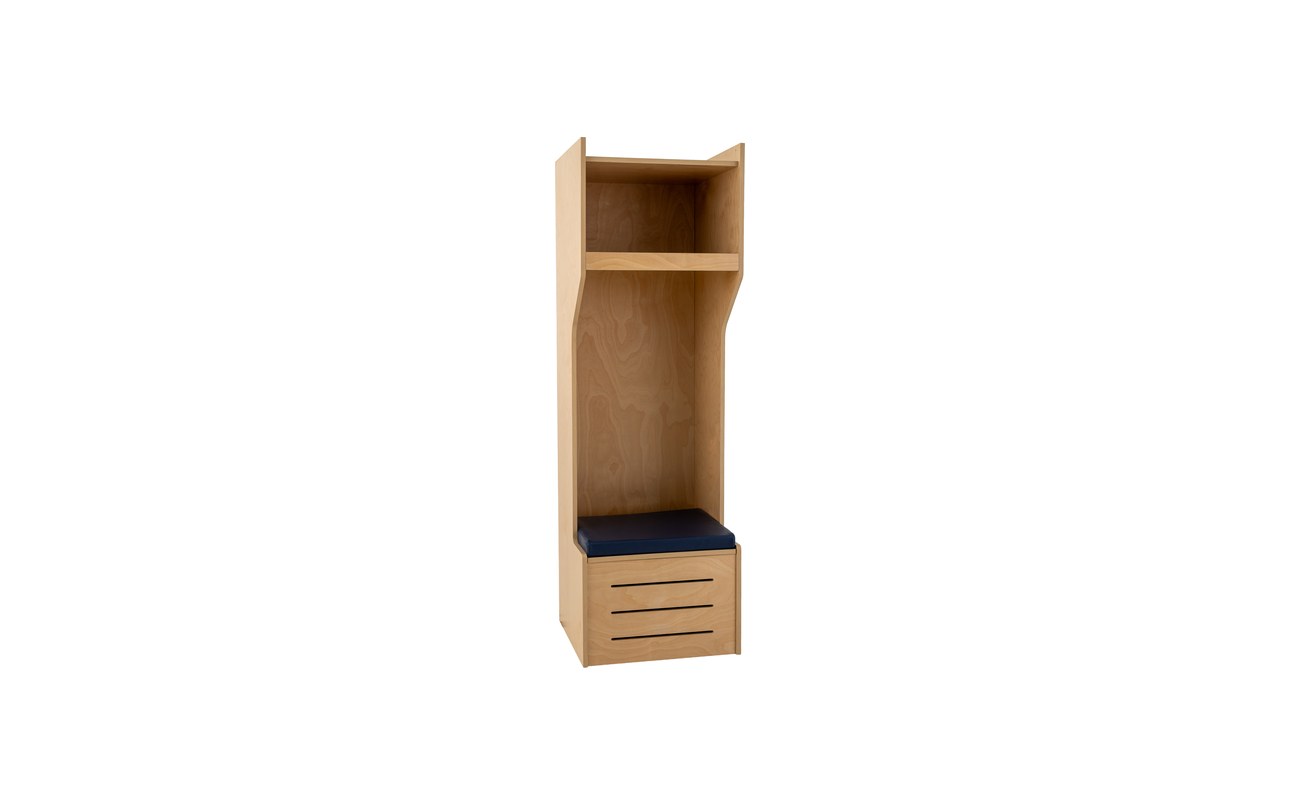
Height at 76” standard gives you overhead storage for helmets and the vertical space for hanging jerseys without cramming. Depth at 24” handles the bulk of pads and skate bags. Our design team specs each Michigan hockey installation individually because roster positions matter: goaltenders need 36”+ to accommodate full goalie kits, and those lockers need to be planned into the layout from the start.
Stick Storage: This Gets Overlooked Until It Becomes a Problem
Every hockey player carries multiple sticks, typically 3–5 at the varsity level, sometimes more. Those sticks can’t go in the locker with everything else; they need dedicated vertical storage that keeps them accessible without damage.
We integrate stick rack systems directly into locker room designs, positioned so players can grab and replace sticks without crossing traffic lanes. Wall-mounted stick racks adjacent to locker bays, numbered to correspond with player lockers, are the standard we recommend. A locker room designed without a stick storage plan ends up with sticks leaning against walls, falling in aisles, and getting damaged. That’s avoidable.
Ventilation: Wet Gear Needs to Dry
Hockey gear is wet after every skate. Skate boots in particular need significant air circulation to dry properly between sessions, and gear that doesn’t dry develops odor and breaks down faster. Standard closed locker doors trap moisture against equipment. That’s wrong for hockey.
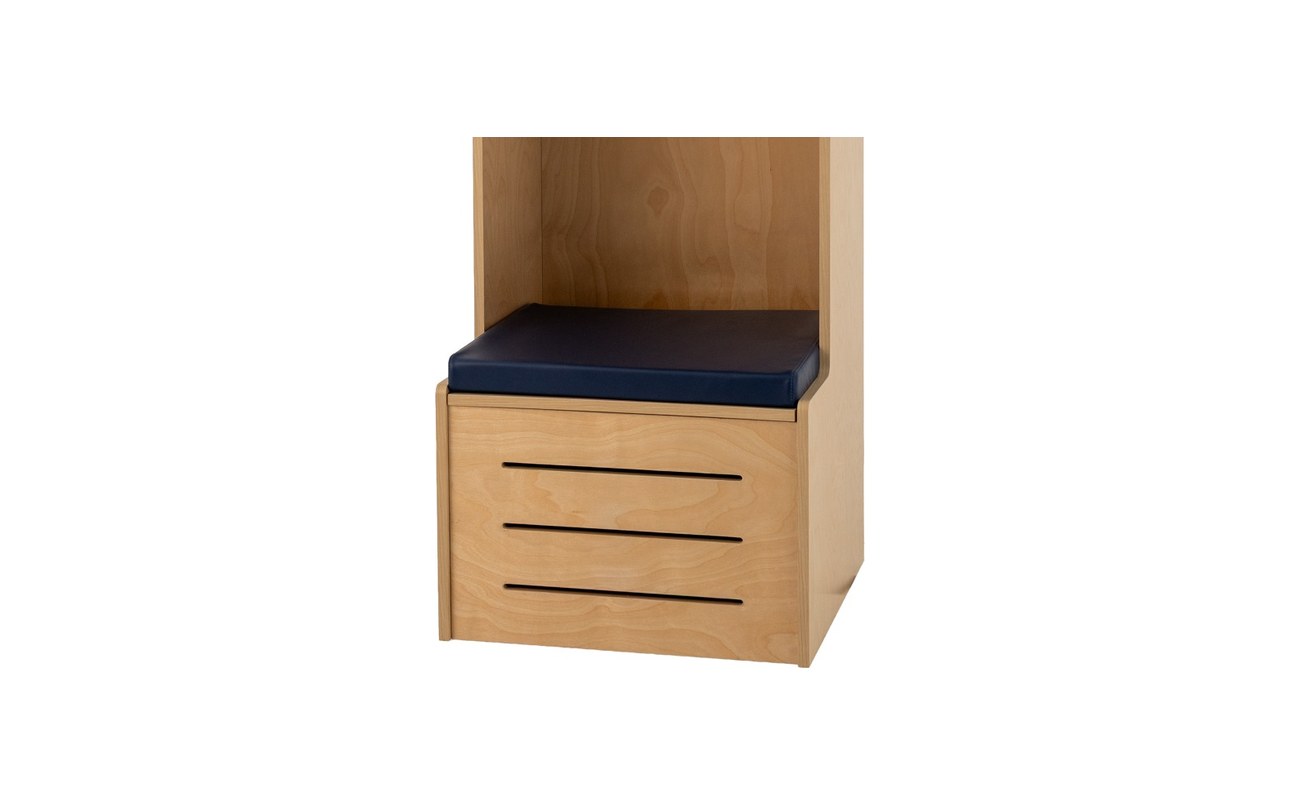
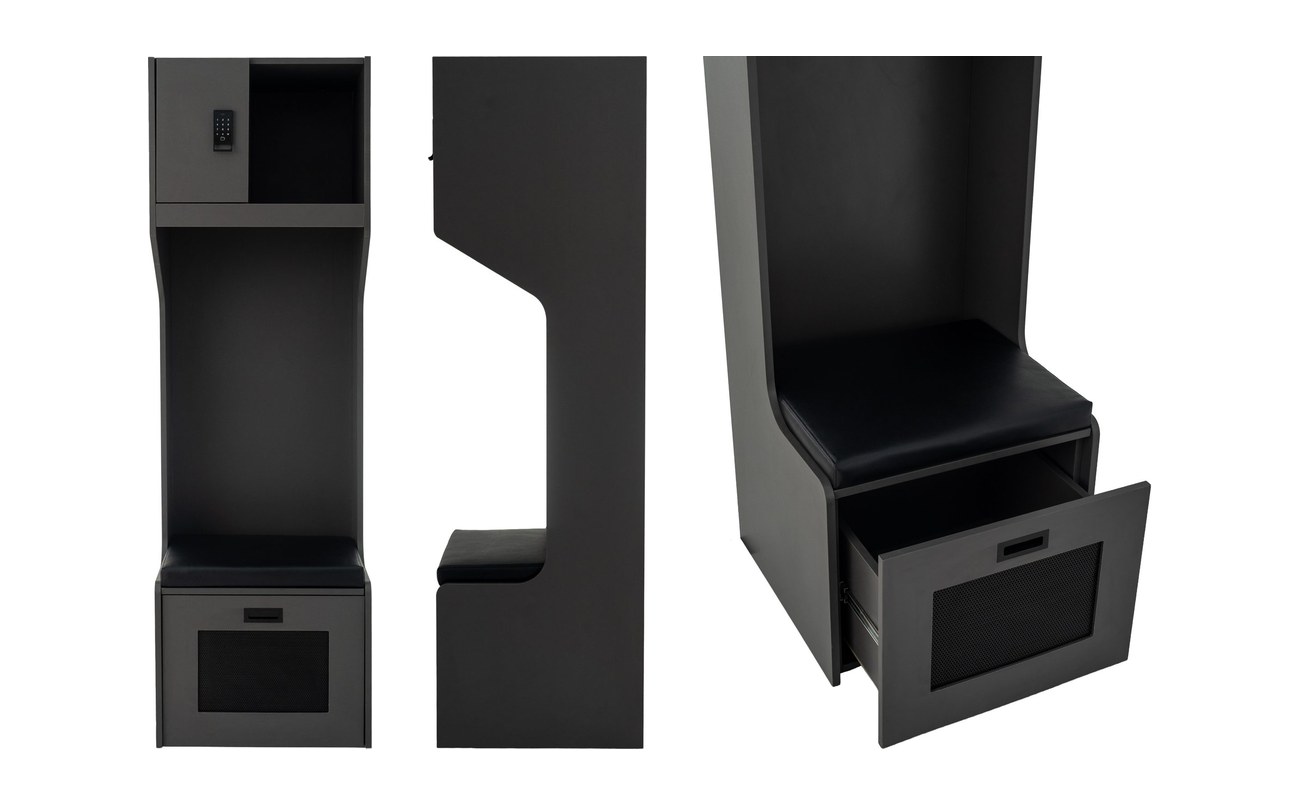
Our hockey installations include ventilated door panels with deliberate airflow gaps, and we recommend that Michigan programs pair locker ventilation with room-level exhaust fans positioned to draw air across the locker bays. The combination keeps gear drier, extends equipment life, and keeps the locker room smelling professional for recruits and visiting parents.
Football and Multi-Sport Locker Rooms in Michigan
Michigan’s football culture is strongest in the southeastern suburbs, communities that send players to Michigan, Michigan State, Notre Dame, and Ohio State regularly. Those programs need locker rooms that compete with what recruits see on campus visits.
Football locker sizing in Michigan follows the same logic as Ohio: 24”–30” wide minimum, 76” tall, 24” deep, with interior configurations that handle two helmets, multiple sets of pads, home and away uniforms, and multiple pairs of footwear. Football lockers in Michigan don’t have hockey’s stick problem, but they have the same volume challenge for pads and helmets.
Multi-sport locker rooms are the reality for most Michigan high schools. A shared locker room serving football in fall, hockey and basketball in winter, and baseball in spring needs locker dimensions sized for the largest equipment (hockey or football) with flexible interior configurations that can be adjusted by season. Our modular interior components let you swap shelf and rod configurations without replacing the locker structure itself, a practical solution for Michigan programs managing multiple sports in one space.
Read our complete renovation planning guide if you’re planning a multi-sport locker room overhaul and need a sequenced planning framework.
Michigan’s Climate and Why Wood Wins
Let’s talk about what Michigan winters do to metal.
A metal locker in a Michigan hockey rink sees salt-soaked boots tracking in every day from October through March. It sees wet jerseys and pads hanging in a space where humidity runs 60–80% after practice. It sees the freeze-thaw cycle that stresses every joint and finish coating. Metal locker paint chips at edges, hardware loosens at expansion joints, and corrosion starts at the base and works upward. Michigan programs that installed metal lockers in the early 2000s are dealing with structural failure right now.
Solid 3/4” birch handles this differently. Wood expands and contracts with humidity changes in a way that maintains structural integrity rather than stressing joints to failure. Our sealed finishes protect the surface from moisture penetration while the built-in ventilation gaps prevent the moisture accumulation that causes interior damage. The analogy that fits: a properly maintained wood deck handles Michigan winters for 20 years; a painted metal deck needs refinishing within five.
Michigan programs that ask us about metal alternatives rarely stick with that conversation for long. The climate argument is too clear. Over a 20-year period, wood lockers in Michigan are significantly cheaper than the combined cost of two or three metal installations.
For a complete material comparison, our 2026 sports lockers buying guide covers every major option with total cost of ownership analysis.
The Canadian Advantage: Why Our Hockey Expertise Matters
We’ve been Canadian-owned and operated since 1989. That’s not a marketing line, it’s the context that explains why Michigan hockey programs call us specifically.
Hockey is embedded in Canadian culture the way football is embedded in Texas. We grew up building locker rooms for hockey programs: Junior A teams, university programs, minor hockey associations, and competitive high school programs across Ontario, Alberta, and British Columbia. By the time we started serving U.S. markets, we had more than a decade of hockey locker room experience that programs in Michigan could actually use.
Michigan programs get that accumulated knowledge directly. We don’t learn hockey locker requirements on your installation, we arrive knowing the stick rack configurations that work, the ventilation gaps that dry skate boots in 12 hours instead of 48, the locker widths that accommodate full goalie kits, and the finish options that survive decades in a rink environment.
That expertise, combined with per-locker prices published openly and a price match against USA competitors, is what makes us worth a conversation for Michigan hockey programs. You can see what a locker costs before you ever ask for a quote.
Contact us for a free consultation and we’ll bring that expertise to your Michigan program’s locker room project.
Funding Locker Room Upgrades in Michigan
Michigan districts have several funding paths for athletic facility improvements. Understanding which one fits your project size and timeline matters before you go to your administration.
Sinking funds are Michigan’s most useful tool for locker room projects. A sinking fund millage allows districts to accumulate capital over time specifically for facility maintenance and improvement, and unlike general bond funding, sinking funds don’t require a supermajority approval in most circumstances. If your district has an active sinking fund, a locker room renovation is a textbook appropriate use. The argument to your administration is straightforward: this is exactly what the fund was designed for.
Bond proposals fund larger renovation packages. Michigan districts regularly put athletic facility bonds on the ballot as part of broader capital improvement proposals. If your district is already planning a bond measure, lobbying to include the locker room renovation is far more efficient than a standalone campaign. Frame it as infrastructure, not athletics spending.
Booster clubs and athletic foundations handle the gap between what public funding covers and what a program actually wants. Michigan has strong booster cultures, particularly in hockey and football communities. A naming rights package attached to the locker room renovation, “The [Family] Hockey Locker Room”, can generate $20,000–$60,000 in contributions, depending on your program’s profile and donor base.
Our athletic director’s selection guide includes a framework for presenting locker room investment proposals to school boards and booster organizations.
Choosing the Right Locker Tier
Here’s how our five tiers map to Michigan high school programs:
Semi Pro ($399), Solid entry-level option for programs doing a first renovation on a limited budget. Not the first choice for hockey programs given equipment volume, but works for basketball-only or baseball-only installations.
Varsity ($499), Strong performer for mid-sized programs. Handles basketball, baseball, and soccer equipment well. Football and hockey programs will find the configuration options limiting at the high end of their equipment needs.
Stadium ($599), The right tier for most Michigan hockey and football programs. Better interior organization depth, enhanced finish quality, and the customization options (team colors, nameplates, logo panels) that matter for recruiting. Programs competing at the MHSAA Division 1 and 2 level typically land here.
Stadium ($599), Built wide. The natural choice for hockey programs that need 30”+ standard widths and want the premium finish quality that reflects the program’s investment in the facility.
Model L ($649), Premium curved-door design with maximum visual impact. Best for flagship hockey or football rooms where the locker room itself is a program statement. Programs that host recruiting events, media days, and community tours get significant return from the custom models’s visual presence.
Every tier is built from solid 3/4” birch, not particleboard, not laminate. Every tier carries our five year guarantee.
Project Costs and Timelines for Michigan Schools
Budget Ranges
A 50–60 locker hockey installation, Varsity or Stadium tier, 30”–36” wide, with stick rack integration and ventilated doors is priced per locker by tier, plus freight and installation. Football rooms at similar locker counts are priced the same way, per locker by tier.
Combined multi-sport rooms with 80–100 lockers serving football and hockey scale with locker count at the same per-locker price. Full facility renovations including flooring, ventilation upgrades, and electrical work require coordination across multiple contractors. We work within broader construction schedules and can sequence our installation accordingly.
The ADA’s accessibility standards apply to Michigan high school athletic facilities, build accessibility in from day one, not as an afterthought.
Timeline Planning
Michigan athletic directors targeting summer installation need to start in January or February. Hockey programs that want lockers ready for October season start should begin the process no later than June. Our fabrication runs 6–10 weeks from confirmed order.
Fabrication is the long pole here, not delivery, which means the date you start matters far more than anything else. That only helps if you’ve started the process. Programs that wait until April for a summer delivery date put themselves in a tight window.
Schedule your free consultation today and we’ll map a project timeline to your Michigan program’s specific calendar.
Frequently Asked Questions
What size lockers do Michigan hockey programs need?
Hockey is the most equipment-intensive high school sport in Michigan, and undersized lockers are the most common mistake we see. A full hockey player kit, skates, helmet, pads, gloves, pants, jersey, sticks, and a bag, requires a locker that is at minimum 30” wide and 24” deep. Many Michigan programs go to 36” for their varsity hockey rooms. You also need integrated stick storage and ventilation gaps that allow skate boots and gear to dry between sessions. We spec every Michigan hockey installation with these requirements built in.
How do Michigan winters affect metal vs. wood lockers?
Michigan winters are brutal on metal locker rooms. Salt-laden boots and wet gear track in moisture all season; the freeze-thaw cycle across the UP and lower peninsula causes metal to expand and contract at joints, loosening hardware and cracking finish coatings. Metal lockers in Michigan hockey rinks often show significant rust and corrosion within 5–8 years. Our solid 3/4” birch construction with sealed finishes handles Michigan’s moisture cycling much better. Wood breathes, it absorbs and releases moisture gradually rather than trapping it at metal joints where corrosion starts.
What’s the lead time for Michigan high school locker deliveries?
Our fabrication lead time runs 6–10 weeks from confirmed order, plus shipping time to your Michigan facility. Fabrication is the long pole, not delivery, and we quote freight as its own visible line so you can see exactly what it costs. For summer installations, place your order no later than April to ensure lockers arrive in June or early July, giving you a comfortable window before fall camp or the start of hockey season in October.
What funding mechanisms do Michigan districts use for locker room upgrades?
Michigan districts most commonly use sinking funds, a dedicated millage mechanism that allows districts to accumulate capital for facility maintenance and improvement over time. Bond proposals also fund major locker room renovations, particularly when they’re part of a broader facility package. Booster clubs and athletic foundations handle the gap between public funding and program wishes. If your district has an active sinking fund, locker room renovation is a highly appropriate use of those dollars and easier to approve than a full bond proposal.
Does PlayerStall have hockey-specific locker expertise?
Yes, and it’s not something we’ve learned recently. We’re Canadian-owned and operated since 1989, which means hockey is in our DNA. We’ve been building lockers for ice hockey programs across Canada and the northern U.S. for three and a half decades. Michigan hockey programs get that experience directly: we know the stick storage configurations that work, the ventilation gaps that dry skate boots properly, and the locker dimensions that fit full goalie kits. We don’t learn hockey on your installation, we bring over 35 years of it.
How many lockers does a typical Michigan high school hockey program need?
Plan for your full varsity and JV rosters plus coaching staff. Most Michigan high school programs have 20–25 varsity players and a similar JV squad. A combined installation of 50–60 lockers handles most programs, with a handful of dedicated goalie lockers sized wider (36”+) for the full goalie kit. Don’t forget to include 4–6 coaching staff lockers. Always plan for the largest roster you realistically expect over the next 5–7 years, retrofitting is more expensive than planning correctly from the start.
Build a Locker Room That Earns Michigan’s Respect
Michigan high school athletics doesn’t tolerate mediocrity. Programs here invest in coaching, conditioning, and facilities because they know the margin between winning and losing culture is real. The locker room is where that culture starts, before every practice, before every game, and during every recruiting visit.
Custom wood sports lockers built for Michigan’s climate, sized for Michigan’s sports, and backed by over 35 years of hockey expertise give your program the foundation it deserves. Metal lockers will cost you more over the long run and less of the performance you’re trying to build. Wood, properly constructed and correctly maintained, will still look and function like new when the players who used it today are coaching their own kids.
We’ve been building these for programs like yours since 1989. We know what Michigan needs.
Start your free design consultation today, we’ll design a locker room built for Michigan’s sports, Michigan’s climate, and your program’s specific goals, backed by our five year guarantee.
Browse our full range of custom wood sports lockers or read the complete 2026 sports lockers buying guide for deeper research.